AurumPCB
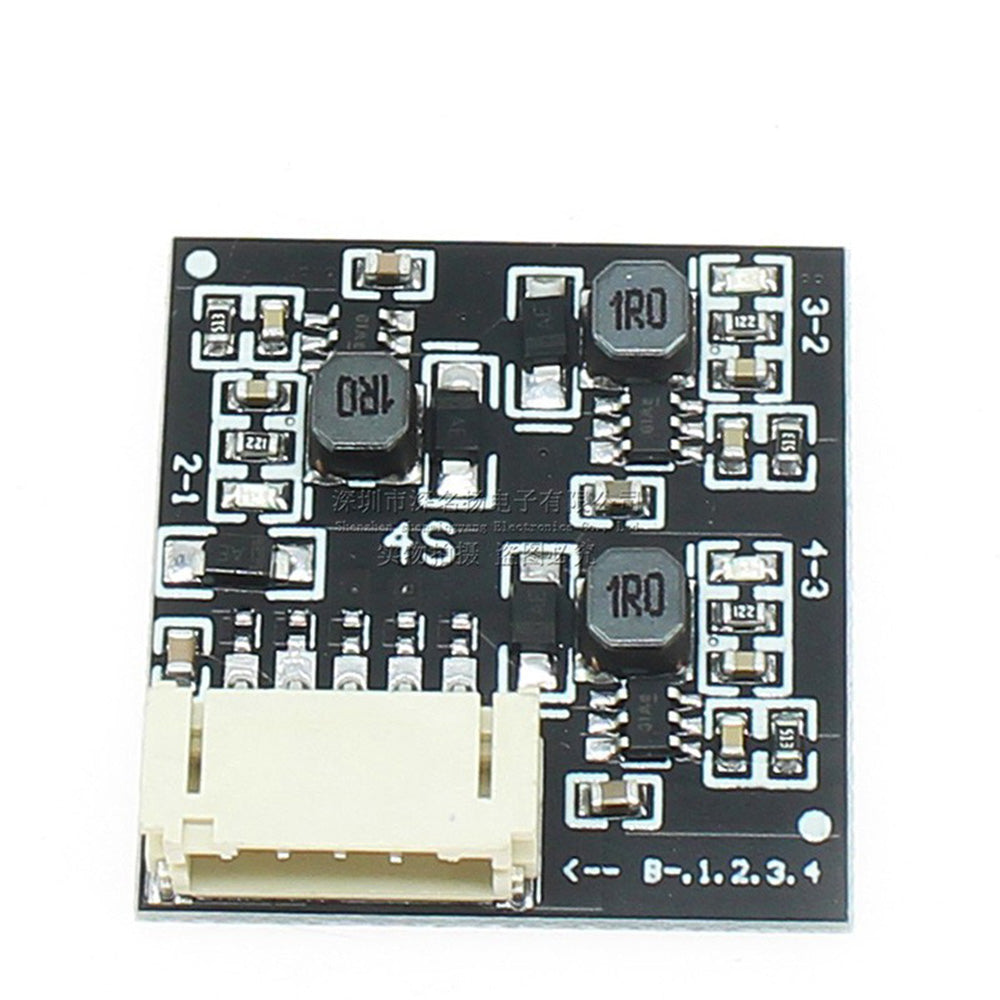
4S High-current active balancing board Lithium battery pack 18650 21700 4String16.8V Energy transfer
4S High-current active balancing board Lithium battery pack 18650 21700 4String16.8V Energy transfer
Couldn't load pickup availability
4S Active Energy-Transfer Balancer for 18650 and 21700 Packs
This active balancing board transfers energy between cells and includes connection wiring. The documentation lists support for selected two-series to four-series lithium packs; confirm the required cell chemistry and wiring before assembly.
Features and use
- Support for selected 2S, 3S, and 4S lithium packs.
- Energy-transfer current is listed as 0.8 A.
- Documented board dimensions are 32 × 29 mm.
Product details
4S Active Balancing
Suitable for 2S/3S/4S lithium battery packs
Universal for 3.2 V 3.7 V lithium batteries
Energy transfer current 0.8 A
Wiring length 20CM

Why does a significant pressure difference still exist after balancing is completed?
Some individual batteries are severely aged and their internal resistance has become very large. At the end of balancing, the voltage difference does indeed reach the 0.03 V standard, but after balancing ends, some changes in battery voltage will occur: the voltage of discharged batteries will rise slightly, and the voltage of charged batteries will drop slightly. This is an illusion caused by the increased internal resistance of severely aged batteries, and the voltage difference between them is not enough to trigger the next balancing cycle. The batteries will show significant improvement after multiple cycles of charging and load use!
Efficiency up to 92%
Low heat generation, can be built into the battery pack
Main body size: 32 × 29 mm
Weight: 8.5g
Wiring diagram of the balancing board and battery pack
0 is the total negative forward connection, wrong connection will burn

Is a balancing current of 0.8 A sufficient?
This means that 0.8 A of electrical energy can be transferred from one battery to another every hour.
Taking a set of 100AH batteries as an example, the maximum capacity difference between cells is 10% (which is already very serious), that is to say, the highest and lowest capacity cells are 100AH and 90AH respectively. Obviously, it takes balancing about 10AH of power to achieve balance.
If using 0.8 A active balancing, the balancing action starts from the first completion of circuit connection, requiring only about 10AH ÷ 0.8 A = 12.5 hours, and the circuit will continuously monitor the cell status. As long as a voltage difference of 0.1 V appears, balancing will be restarted until the voltage difference reaches the standard value of 0.03 V.
However, using conventional 0.06 A passive balancing generally requires plugging in the charger for 2 hours to wait for the battery to be partially charged, then passive balancing slowly discharges the high-potential cells. This discharge process is approximately 10AH ÷ 0.06 A = 166 hours, and the charger cannot be unplugged during this process.
Can be built into the battery pack
92% Conversion Efficiency